

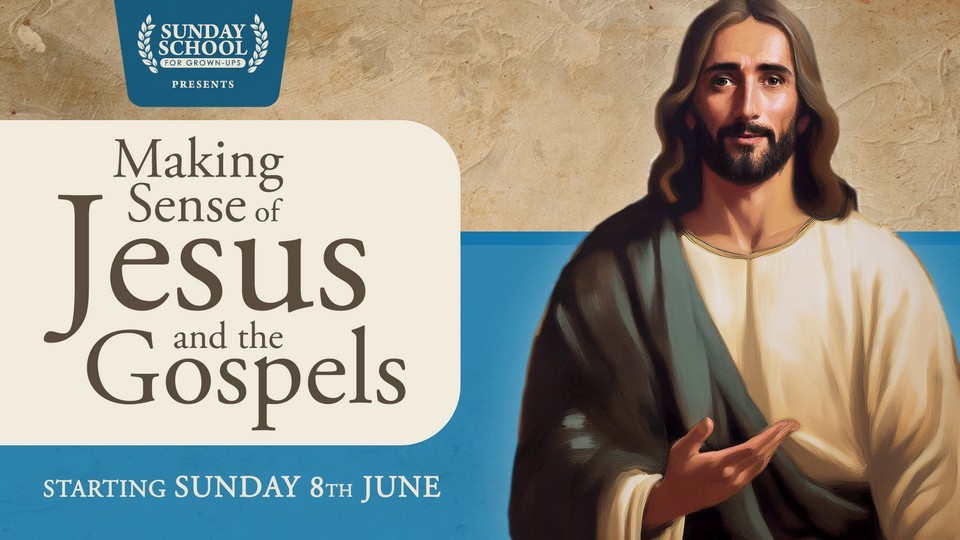
This, the fourth of the 'Sunday School for Grown-Ups' courses, began in June 2025. In it we explore some of the different approaches that people have used to understand Jesus in his historical context, and take a closer look at how the writers of the four gospels - Matthew, Mark, Luke, and John - each tell his story in their own unique way.
All sessions were led by Stephen Kuhrt, except where otherwise stated.
| Session | Topic and scope |
|---|---|
|
1 |
The Historical Jesus (Part 1). The first session focused on the so-called 'Quest for the Historical Jesus' that took place from the eighteenth century onwards and sought to distinguish 'the Jesus of history' from 'the Christ of faith'. This involved learning from the considerable insights but also wrong-turnings and mistakes that biblical scholars have made as they have tried to get to grips with who Jesus was and is and the nature of his mission and activity. |
|
2 |
The Historical Jesus (Part 2). Looking at the so-called 'New Quest for Historical Jesus' that took off from the 1980s through the work of the Jesus Seminar in America and the work of scholars such as Dominic Crossan and Burton Mack. Dominated by scepticism about the gospels and faith of the early church, most of these scholars depicted the historical Jesus as a simple but radical teacher quite different from the subsequent 'Christ of faith'. This poses important questions about what made this reconstruction of Jesus so attractive to Western society at the time, as well of course as the questions of what it got right and what it got wrong. |
|
3 |
The Historical Jesus (Part 3). This session examined those who insisted on interpreting Jesus within the context of first century Judaism. This led to the so-called 'Third Quest for the Historical Jesus' which (in contrast to the 'New Quest') made eschatology (ie. God's imminent, dramatic action) central to Jesus' understanding of his ministry. |
|
4 |
The Historical Jesus (Part 4). Covering further examples of the 'Third Quest for the Historical Jesus' and the methodology that can help us understand the historical Jesus best and integrate the various diverse aspects of his ministry into a coherent whole. |
|
5 |
The Historical Background of Jesus. Examining at the historical context of Jesus' ministry - the political situation in Palestine in the first century, the nature of Roman rule, the various Jewish groups and factions and the core elements in Jewish belief. |
|
6 |
Jesus and the Kingdom of God (Part 1). Looking at different interpretations of what Jesus was referring to when he proclaimed the coming of the kingdom of God and the role within this proclamation of Jesus' healings, exorcisms, eating with sinners and challenge to established authority. |
|
7 |
Jesus and the Kingdom of God (Part 2). Covering the meaning of his call to repentance, the nature of the parables, the message of the Sermon on the Mount and the coming judgement he proclaimed. |
|
8 |
The Identity of Jesus (Part 1). Unpacking what it means to understand Jesus as 'Son of Man', 'Son of David' and 'Messiah/Christ'. |
|
9 |
The Identity of Jesus (Part 2). Focusing on the question of whether Jesus thought he was God - looking at Jesus' words, and particularly his actions, against the context of first century Judaism and its understanding of God. |
|
10 |
The Death of Jesus (Part 1). Looking at the Roman and Jewish factors involved, the question of its intentionality on Jesus' part, the Scriptures that informed Jesus' vocation to die in Jerusalem, and the connection with his earlier ministry. |
|
11 |
The Death of Jesus (Part 2). Considering the role of the references that Jesus made to his death, the role of the Last Supper in understanding it, the connection between Jesus' death and the judgement he proclaimed upon Jerusalem, and its role in defeating the kingdoms of the world and the power of evil. |
|
12 |
The Resurrection of Jesus (Part 1). Examining what first century Jews already believed about resurrection and their future hope as part of exploring what the resurrection of Jesus meant while also looking at the nature of the resurrection stories in the gospels and what they reveal about its nature of the event at the heart of our Christian faith. |
|
13 |
The Resurrection of Jesus (Part 2). Looking at the resurrection accounts in Mark, Matthew, Luke and John, and the references to resurrection throughout the gospels. |
|
14 |
The Nature of the Gospels. Looking at the type of literature the gospels are, and the critical questions of the extent to which they represent authentic witness to Jesus or early Christian belief in narrative form. |
|
15 |
The Message of the Gospels (Part 1). Addressing how we integrate the four gospels’ emphasis on Jesus proclamation of the Kingdom of God, both in word and deed, and how each of the gospel writers handles Jesus’ death and resurrection. |
|
16 |
The Message of the Gospels (Part 2). Considering how the themes of kingdom and cross connect within Matthew, Mark, Luke and John, as they tell the story of 'How God became king'. |
|
17 |
The Message of the Gospels (Part 3). Looking at the way in which the themes of Kingdom and Cross become one in the presentation of Jesus' Messiahship and how each of the four gospels present the death of Jesus. |
|
18 |
The Gospel of Mark (Part 1). |